
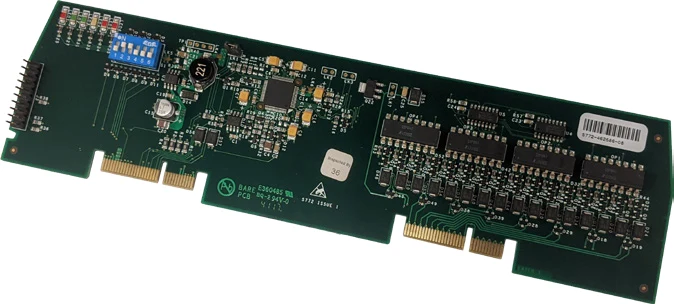
Product overview
The VES 16 Channel I/O Interface provides configurable input and output channels for a compatible L@titude panel. Its circuit role and electrical limits must be coordinated with the compatible panel and approved fire alarm design. The model-specific data below distinguishes the interface configuration, supply requirements and installation conditions so the exact version can be selected for the project. The inputs are not supervised and must not be used for life-safety initiation within a UL-listed system; the manufacturer also specifies enclosure, conduit and listed power-supply requirements for UL applications.
Technical specifications
| Manufacturer | Kentec Electronics Ltd. |
|---|---|
| Brand / product range | VES |
| Product / system | 16 Channel I/O Interface |
| Product type | Fire Detection |
| Product family | Fire Detection & Alarm |
| Subcategory | Addressable Modules |
| Versions | S560 interface board / S772 panel module |
| Channels | 16, individually configured as inputs or outputs |
| Compatible platform | L@titude fire alarm control panel |
| Board quantity | Up to four per 2–8 loop panel / eight per 2–16 loop panel |
| Supply voltage | 24 V DC |
| Quiescent current | 20 mA |
| Current per input | 3 mA maximum for S560; 3 mA stated for S772 |
| Input supervision | Unsupervised; not for life-safety initiation in a UL-listed system |
| Output technology | Open-collector transistor |
| S560 output rating | 100 mA per output / 500 mA across a bank of eight |
| S772 output rating | 100 mA per output / 400 mA across a bank of eight |
| S560 dimensions H x W | 7.5 x 2.5 inches |
| S772 dimensions | 234.6 x 62.8 mm |
| Operating temperature | S560: 0°C to +50°C / S772: −5°C to +49°C |
| Humidity | Up to 95%, non-condensing |
Key features
- Versions: S560 interface board / S772 panel module
- Channels: 16, individually configured as inputs or outputs
- Compatible platform: L@titude fire alarm control panel
Applications
Ancillary configurable I/O functions where the documented supervision limitations and enclosure requirements are acceptable to the system design.
Selection and project integration
Share the fire alarm drawings, equipment schedule, compatible panel platform and cause-and-effect requirements with UDCT. Selection should confirm device protocols, supported interfaces, circuit supervision, power and standby calculations, and the exact enclosure or module arrangement.
Use the current manufacturer documentation to check compatibility, wiring limits, software requirements and approval scope. Commissioning should verify the configured alarm, fault, indication and control functions as part of the complete system. Remote reporting also requires a compatible receiving service and confirmation of local network availability.
Manufacturer documents
Official product reference
View this product on the manufacturer website (opens in a new tab)