
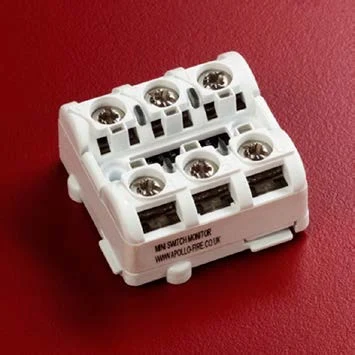
Product overview
The VES mini input-module range monitors voltage-free contacts where installation space is limited. The shared sheet covers three products with different functions: VF5660 provides priority monitoring, VF5661 provides compact switch monitoring, and VF5608 adds configurable interrupt behaviour and isolation. Select the exact module, panel type code and field-wiring arrangement together. Electrical values shown specifically for VF5608 do not establish the ratings of the other two models.
Technical specifications
| Brand / product range | VES |
|---|---|
| Product / system | Apollo Mini Input Modules |
| Product type | Fire Detection |
| Product family | Fire Detection & Alarm |
| Subcategory | Apollo Modules |
| Range | VF5660 mini priority switch monitor; VF5661 mini switch monitor; VF5608 mini monitor |
| Common purpose | Monitor voltage-free contacts and report normal, fault and alarm states to compatible Apollo control equipment |
| VF5660 | Priority interrupt; Class A or B input capability |
| VF5661 | Compact loop-powered contact-monitoring module |
| VF5608 supply | 17–28 V DC |
| VF5608 quiescent current | 200 µA at 24 V |
| VF5608 local alarm LED load | 3.4 mA plus quiescent current |
| VF5608 remote and local LED alarm load | 6.2 mA plus quiescent current |
| VF5608 switch-fault LED load | Additional 2.8 mA, pulsing 0.5 seconds on / 0.5 seconds off |
| VF5608 features | Short-circuit isolator; configurable interrupt / non-interrupt; DIN-rail or electrical-box mounting |
| VF5608 input resistors | 1 kΩ alarm / 20 kΩ end of line, in the referenced wiring diagram |
| Variant limitation | VF5608 electrical data must not be applied to VF5660 or VF5661 without their installation documentation |
Key features
- Range: VF5660 mini priority switch monitor; VF5661 mini switch monitor; VF5608 mini monitor
- Common purpose: Monitor voltage-free contacts and report normal, fault and alarm states to compatible Apollo control equipment
- VF5660: Priority interrupt; Class A or B input capability
Applications
Compact contact-monitoring interfaces in compatible Apollo-protocol systems, including documented pull-station and ancillary equipment arrangements. Confirm supervision, response priority and mounting requirements for the chosen module.
Selection and project integration
Share the fire alarm drawings, equipment schedule, compatible panel platform and cause-and-effect requirements with UDCT. Selection should confirm device protocols, supported interfaces, circuit supervision, power and standby calculations, and the exact enclosure or module arrangement.
Use the current manufacturer documentation to check compatibility, wiring limits, software requirements and approval scope. Commissioning should verify the configured alarm, fault, indication and control functions as part of the complete system. Remote reporting also requires a compatible receiving service and confirmation of local network availability.
Manufacturer documents
Official product reference
View this product on the manufacturer website (opens in a new tab)