
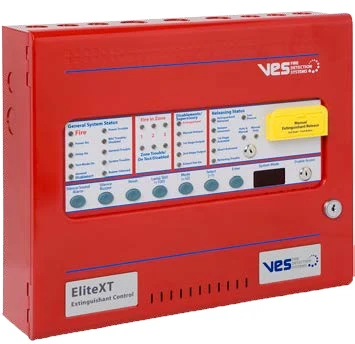
Product overview
The VES Elite XT is a conventional releasing-control panel with three detection zones and configurable release logic. Its staged indication, remote status interfaces and monitored inputs support a specifically engineered suppression installation. Select the mains variant, detection arrangement, releasing load and delay configuration together with the compatible suppression equipment and approved cause-and-effect schedule.
Technical specifications
| Manufacturer | Kentec Electronics Ltd. |
|---|---|
| Brand / product range | VES |
| Product / system | Elite XT Releasing Fire Control Panel |
| Product type | Fire Detection |
| Product family | Releasing & Control |
| Subcategory | Releasing |
| Models | VF1810-10 / VF1810-11 red; VF1810-40 / VF1810-41 gray |
| AC supply choices | 115 / 230 V AC, selected suffix applies |
| Detection zones | Three |
| Maximum detectors per zone | 32, dependent on detector type and system compatibility |
| Power supply | 3 A total including battery charging, 28 V ± 2 V |
| Battery arrangement | Two 12 V, 7 Ah sealed lead-acid batteries in series |
| Battery charge current | 0.7 A maximum |
| Releasing output | 1 A |
| Releasing delay / duration | 0–60 seconds / 60–300 seconds, in five-second steps |
| Status indicators | Up to seven compatible remote status units |
| Serial interface | Two-wire RS485 plus power for status units / ancillary boards |
| Manufacturer-listed approvals | UL 864 / FM approval stated by manufacturer, exact configuration applies |
Approval scope applies to the listed system and component configuration. Confirm the selected equipment against the current manufacturer document and project submittal.
Key features
- Models: VF1810-10 / VF1810-11 red; VF1810-40 / VF1810-41 gray
- AC supply choices: 115 / 230 V AC, selected suffix applies
- Detection zones: Three
Applications
Engineered fire-suppression control arrangements requiring coordinated detection, release supervision, manual controls and system status indication. Configuration and commissioning require the current manufacturer instructions and approved project design.
Selection and project integration
Share the fire alarm drawings, equipment schedule, compatible panel platform and cause-and-effect requirements with UDCT. Selection should confirm device protocols, supported interfaces, circuit supervision, power and standby calculations, and the exact enclosure or module arrangement.
Use the current manufacturer documentation to check compatibility, wiring limits, software requirements and approval scope. Commissioning should verify the configured alarm, fault, indication and control functions as part of the complete system. Remote reporting also requires a compatible receiving service and confirmation of local network availability.
Manufacturer documents
Official product reference
View this product on the manufacturer website (opens in a new tab)