
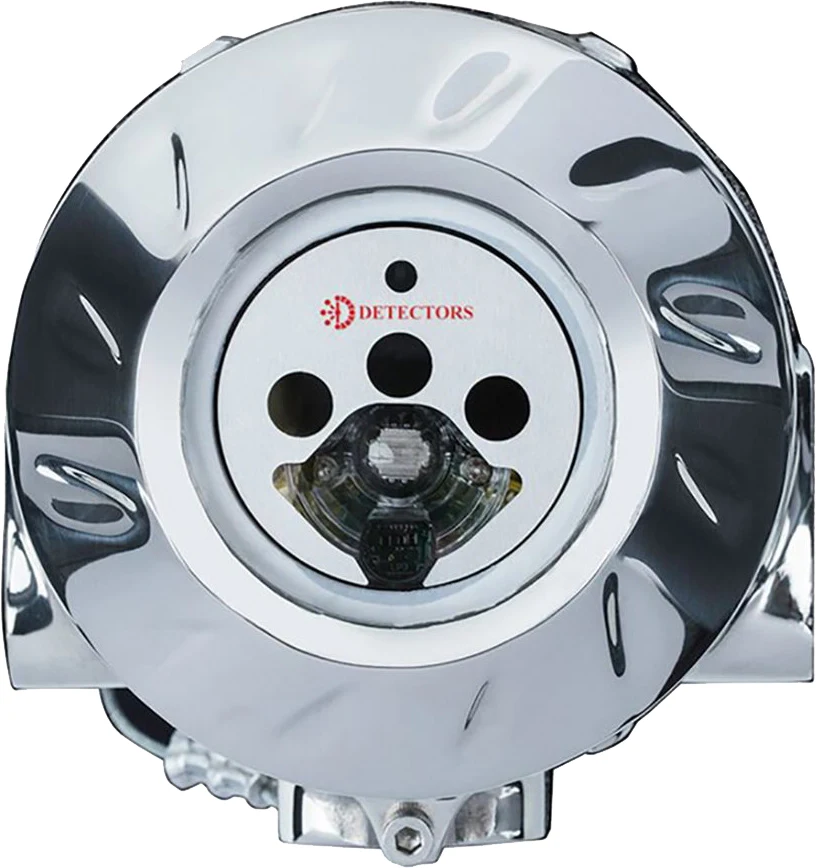
Product overview
The Detectors Inc. D371 3IR+UV is a multi-spectrum flame detector presented in the VES product portfolio. It combines ultraviolet sensing with three infrared bands and provides relay and communication interfaces for a compatible fire-and-gas design. Select sensitivity, heater option, enclosure entry and output configuration for the application. Detection distance depends on the specified fuel, test conditions and exact approved configuration, so a single blanket range is not used here.
Technical specifications
| Manufacturer | Detectors Inc. |
|---|---|
| Brand / product range | VES |
| Product / system | Model D371 3IR+UV Flame Detector |
| Product type | Fire Detection |
| Product family | Fire Detection & Alarm |
| Subcategory | Conventional |
| Model | D371 3IR+UV |
| Sensing method | UV plus three infrared spectral bands |
| Field of view | 90 degrees |
| Supply | 24 V DC nominal, regulated 18–31 V DC |
| Standby / alarm current | 60 mA / 90 mA at 24 V DC |
| Optional heater | 120 mA additional current |
| Relay outputs | Alarm / auxiliary / fault, SPDT contacts rated 2 A at 24 V DC |
| Communications | RS485 Modbus |
| Event memory | 200 events / six FireGraphs |
| Enclosure | 316 stainless steel, NEMA 4 / 4X, IP66 / IP67 |
| Weight | 4.5 kg (10 lb), excluding optional mounting arm |
| Operating temperature | −55°C to +85°C; lower-temperature operation requires the documented internal-heater configuration |
| Humidity | 5–95%, non-condensing |
| Detection-range selection | Depends on fuel, sensitivity, approved configuration and test conditions; obtain confirmed application-specific range |
Key features
- Model: D371 3IR+UV
- Manufacturer: Detectors Inc.
- Sensing method: UV plus three infrared spectral bands
Applications
Engineered flame-detection applications in suitable industrial, fuel-handling, process and energy facilities, subject to the application-specific detection study and exact product approval scope.
Selection and project integration
Share the fire alarm drawings, equipment schedule, compatible panel platform and cause-and-effect requirements with UDCT. Selection should confirm device protocols, supported interfaces, circuit supervision, power and standby calculations, and the exact enclosure or module arrangement.
Use the current manufacturer documentation to check compatibility, wiring limits, software requirements and approval scope. Commissioning should verify the configured alarm, fault, indication and control functions as part of the complete system. Remote reporting also requires a compatible receiving service and confirmation of local network availability.
Manufacturer documents
Official product reference
View this product on the manufacturer website (opens in a new tab)