
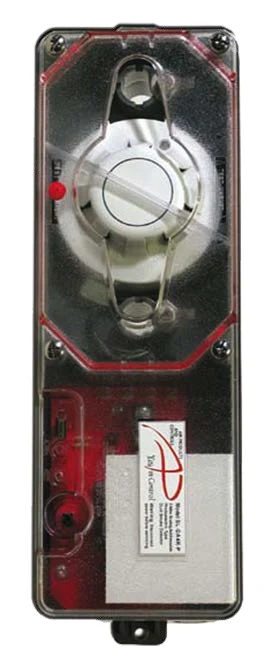
Product overview
The VES VF4992 monitors smoke carried through HVAC ducts using the specified XP95A ionization or photoelectric sensing arrangement. A selected sampling tube conveys duct air to the detector, and documented relay and accessory interfaces support the approved air-handling response. Selection must account for duct width, air velocity, detector compatibility, external power and the actual controlled load. Duct monitoring supports the building fire strategy and does not replace required open-area smoke detection.
Technical specifications
| Brand / product range | VES |
|---|---|
| Product / system | VF4992 Duct Smoke Detector |
| Product type | Fire Detection |
| Product family | Fire Detection & Alarm |
| Subcategory | Apollo Addressable |
| Model family | VF4992, ionization or photoelectric duct smoke detection |
| Panel compatibility | Apollo XP95 and/or Discovery protocol, using the documented detector combination |
| Supply | 24 V AC or 24 V DC |
| Air velocity | 100–4,000 feet/minute |
| Control-board standby load | 105 mA at 24 V AC / 26 mA at 24 V DC, without accessories |
| Control-board alarm load | 195 mA at 24 V AC / 54 mA at 24 V DC, without accessories |
| Sampling tubes | Select STN-1.0 / STN-2.5 / STN-5.0 / STN-10.0 to match the documented duct-width range |
| Humidity | 10–95% RH, non-condensing and non-freezing |
| Dimensions L x W x H | 13.5 x 4.5 x 2.25 inches |
| Maximum net weight | 2.25 lb |
| Enclosure | Gray plastic backbox and clear plastic cover |
| Relay load selection | Use the installation manual; the source specification row contains a corrupted DC rating while the wiring diagram gives separate AC/DC and motor limits |
| Installation scope | Duct smoke monitoring; not a substitute for required open-area detection |
Key features
- Model family: VF4992, ionization or photoelectric duct smoke detection
- Panel compatibility: Apollo XP95 and/or Discovery protocol, using the documented detector combination
- Supply: 24 V AC or 24 V DC
Applications
Compatible commercial, industrial or residential HVAC duct-monitoring arrangements. Verify sampling-tube installation, airflow direction, access for testing and the engineered fan or damper response.
Selection and project integration
Share the fire alarm drawings, equipment schedule, compatible panel platform and cause-and-effect requirements with UDCT. Selection should confirm device protocols, supported interfaces, circuit supervision, power and standby calculations, and the exact enclosure or module arrangement.
Use the current manufacturer documentation to check compatibility, wiring limits, software requirements and approval scope. Commissioning should verify the configured alarm, fault, indication and control functions as part of the complete system. Remote reporting also requires a compatible receiving service and confirmation of local network availability.
Manufacturer documents
Official product reference
View this product on the manufacturer website (opens in a new tab)