
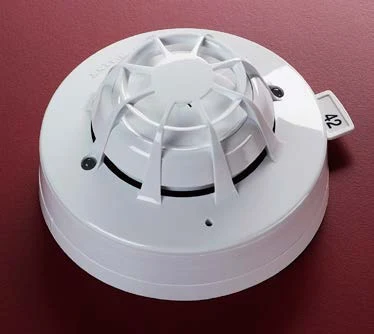
Product overview
The VES VF5603 Discovery multisensor combines an optical smoke chamber and a thermistor. Its processing uses the selected mode to determine how smoke and temperature information contribute to the reported value. Some modes provide combined behaviour, while the documented heat-only mode requires heat-detector coverage and testing. Confirm the exact programmed mode against the current manufacturer instructions; a multisensor must not be assumed to provide identical smoke and heat protection in every configuration.
Technical specifications
| Brand / product range | VES |
|---|---|
| Product / system | VF5603 Discovery Multisensor |
| Product type | Fire Detection |
| Product family | Fire Detection & Alarm |
| Subcategory | Apollo Addressable |
| Model | VF5603-00 |
| Detection elements | Photoelectric smoke chamber and thermistor temperature sensor |
| Compatible panel family | Elite / Elite RS with the documented Apollo-protocol configuration |
| Response modes | Five selectable modes including smoke, combined and heat-only behaviour |
| Mode 5 | Heat-only response; apply heat-detector spacing and coverage |
| Configuration note | The source mode table and prose differ on the heat response in Mode 2; confirm the current programming instructions before specifying that mode |
| Operating voltage | 17–28 V DC |
| Standby current | 500 µA |
| Alarm current | 3.5 mA |
| Addressing | XPERT card in the compatible base |
| Continuous operating temperature | 32°F to 140°F |
| Dimensions | 3.93 inch diameter x 1.65 inch high; 1.96 inch in base |
| Detector weight | 3.68 oz |
| Accessories | Compatible base and address card ordered separately |
Key features
- Model: VF5603-00
- Detection elements: Photoelectric smoke chamber and thermistor temperature sensor
- Compatible panel family: Elite / Elite RS with the documented Apollo-protocol configuration
Applications
Compatible addressable detection designs requiring a documented combination of smoke and temperature response. Select and test the operating mode for the environmental conditions and required detection coverage.
Selection and project integration
Share the fire alarm drawings, equipment schedule, compatible panel platform and cause-and-effect requirements with UDCT. Selection should confirm device protocols, supported interfaces, circuit supervision, power and standby calculations, and the exact enclosure or module arrangement.
Use the current manufacturer documentation to check compatibility, wiring limits, software requirements and approval scope. Commissioning should verify the configured alarm, fault, indication and control functions as part of the complete system. Remote reporting also requires a compatible receiving service and confirmation of local network availability.
Manufacturer documents
Official product reference
View this product on the manufacturer website (opens in a new tab)