
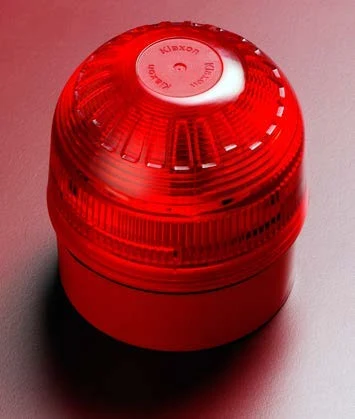
Product overview
The VES VF5652 Discovery open-area sounder beacon provides audible and visual warning through a compatible addressable system. It offers selectable tones and volume levels, with independent sounder and beacon control when the panel supports the full Discovery feature set. The supplied base includes short-circuit isolation. Commissioning must define the tone, sound level, control logic and documented automatic-silence behaviour for the approved notification strategy.
Technical specifications
| Brand / product range | VES |
|---|---|
| Product / system | VF5652 Discovery Open Area Sounder Beacon |
| Product type | Fire Detection |
| Product family | Fire Detection & Alarm |
| Subcategory | Apollo Addressable |
| Models | VF5652-10 red / VF5652-30 white |
| Protocol | Discovery; full feature set requires a compatible panel programmed for full Discovery control |
| Operating voltage | 17–28 V DC |
| Protocol pulses | 5–9 V |
| Quiescent current at 24 V | 430 µA |
| Switch-on surge | 1.2 mA for less than one second |
| Maximum-volume operating current | 8.2 mA at 24 V |
| Maximum sound output | 100 dB(A) at 90 degrees, as stated in the sheet |
| Tone options | 15 evacuation tones and 15 secondary / alert tones |
| Volume settings | Seven |
| Control | Sounder and beacon may be controlled independently when supported |
| Isolation | Mounting base incorporates a short-circuit isolator |
| Sounder timer | Automatically silences after 20 minutes, as stated in the source |
| Operating temperature | −4°F to 140°F |
| Humidity | 0–95%, without condensation |
Key features
- Models: VF5652-10 red / VF5652-30 white
- Protocol: Discovery; full feature set requires a compatible panel programmed for full Discovery control
- Operating voltage: 17–28 V DC
Applications
Compatible Discovery fire alarm designs requiring coordinated audible and visual indication. Verify supported panel functions, circuit loading, required duration and project coverage before selection.
Selection and project integration
Share the fire alarm drawings, equipment schedule, compatible panel platform and cause-and-effect requirements with UDCT. Selection should confirm device protocols, supported interfaces, circuit supervision, power and standby calculations, and the exact enclosure or module arrangement.
Use the current manufacturer documentation to check compatibility, wiring limits, software requirements and approval scope. Commissioning should verify the configured alarm, fault, indication and control functions as part of the complete system. Remote reporting also requires a compatible receiving service and confirmation of local network availability.
Manufacturer documents
Official product reference
View this product on the manufacturer website (opens in a new tab)