
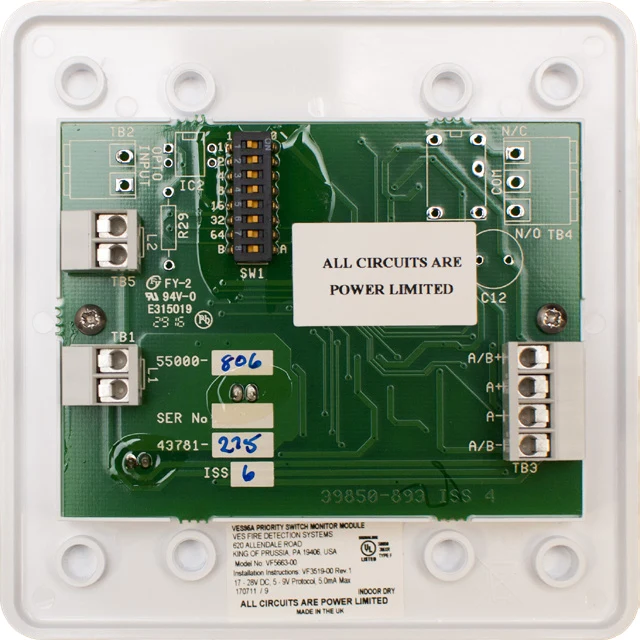
Product overview
The VES VF5663 VES95A priority switch monitor supervises a dry-contact input and reports its state to compatible fire alarm control equipment. It supports the documented Class A or Class B input arrangement and uses loop power. The red LED follows polling and active-state indication. Coordinate contact supervision, interface compatibility and the selected mounting box with the approved initiating-device and cause-and-effect schedule.
Technical specifications
| Brand / product range | VES |
|---|---|
| Product / system | VF5663-00 Priority Switch Monitor |
| Product type | Fire Detection |
| Product family | Fire Detection & Alarm |
| Subcategory | Apollo Modules |
| Model | VF5663-00 |
| Function | Priority dry-contact monitoring |
| Input states | Normal, fault and alarm |
| Input configuration | Class A or Class B |
| Power | Loop powered; supervised power-limited SLC |
| Working voltage | 17–28 V DC |
| Modulation voltage | 5–9 V peak to peak |
| Supervisory current | 0.85 mA |
| Surge current | 2.5 mA |
| Maximum alarm current | 3.5 mA |
| Dimensions | 4.5 x 4.5 x 1 inches |
| Mounting | Two-gang or 4 inch square electrical box |
| Temperature | 32°F to 120°F |
| Humidity | 10–93%, non-condensing |
| Indicator | One red status LED |
Key features
- Model: VF5663-00
- Function: Priority dry-contact monitoring
- Input states: Normal, fault and alarm
Applications
Monitoring compatible dry-contact initiating devices where the system design requires the documented priority response and supervised input arrangement.
Selection and project integration
Share the fire alarm drawings, equipment schedule, compatible panel platform and cause-and-effect requirements with UDCT. Selection should confirm device protocols, supported interfaces, circuit supervision, power and standby calculations, and the exact enclosure or module arrangement.
Use the current manufacturer documentation to check compatibility, wiring limits, software requirements and approval scope. Commissioning should verify the configured alarm, fault, indication and control functions as part of the complete system. Remote reporting also requires a compatible receiving service and confirmation of local network availability.
Manufacturer documents
Official product reference
View this product on the manufacturer website (opens in a new tab)