
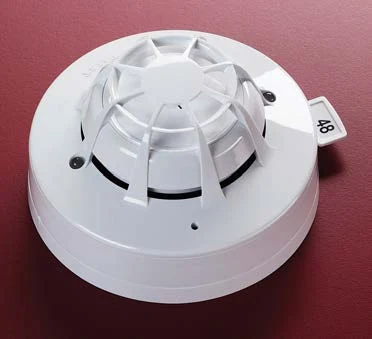
Product overview
The VES VF5671 XP95A multisensor combines optical smoke sensing with temperature information from a thermistor. The processor uses rate-of-rise information alongside the smoke signal, so the device must not be treated as an independent fixed-temperature heat detector. The model is identified by the heading and technical specification of its dedicated VES sheet. Select the compatible base, panel configuration and detection coverage together with the approved fire strategy.
Technical specifications
| Brand / product range | VES |
|---|---|
| Product / system | VF5671 XP95A Multisensor |
| Product type | Fire Detection |
| Product family | Fire Detection & Alarm |
| Subcategory | Apollo Addressable |
| Model | VF5671-00 |
| Detection elements | Photoelectric smoke chamber and thermistor |
| Protocol | Apollo XP95, 5–9 V peak-to-peak communication |
| Supply | 17–28 V DC |
| Quiescent current | 500 µA average / 750 µA peak |
| Power-up surge | 1 mA |
| Maximum power-up time | 10 seconds |
| Alarm LED current | 3.5 mA |
| Remote indicator | 4 mA at 5 V across the remote load |
| Continuous operating temperature | 32°F to 140°F |
| Minimum operating temperature | −4°F only without condensation or icing |
| Humidity | 0–95%, non-condensing |
| Protection rating | IP23D |
| Dimensions | 3.93 inch diameter x 1.96 inch high; 2.28 inch in base |
| Heat-response limitation | Combined processing uses rate-of-rise information; the sheet states that a slow temperature rise alone does not generate the same heat response |
| Identity note | The heading, operation and technical section identify VF5671; a different model number in one overview paragraph is not used as the ordering identity |
Key features
- Model: VF5671-00
- Detection elements: Photoelectric smoke chamber and thermistor
- Protocol: Apollo XP95, 5–9 V peak-to-peak communication
Applications
Compatible addressable installations requiring the documented combined smoke and rate-of-rise response. Confirm detector spacing, panel support and the permitted environmental conditions for the selected system.
Selection and project integration
Share the fire alarm drawings, equipment schedule, compatible panel platform and cause-and-effect requirements with UDCT. Selection should confirm device protocols, supported interfaces, circuit supervision, power and standby calculations, and the exact enclosure or module arrangement.
Use the current manufacturer documentation to check compatibility, wiring limits, software requirements and approval scope. Commissioning should verify the configured alarm, fault, indication and control functions as part of the complete system. Remote reporting also requires a compatible receiving service and confirmation of local network availability.
Manufacturer documents
Official product reference
View this product on the manufacturer website (opens in a new tab)