
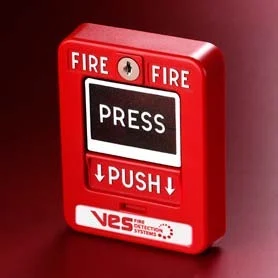
Product overview
The VES VF5688-10 provides dual-action manual alarm initiation with an integral Apollo-compatible addressable interface. Pushing and pulling the handle latches the station in its activated state, revealing a visible flag; a key releases and resets the mechanism. The station address is set locally using the DIP switch. Select the panel compatibility, mounting arrangement and listed operating-voltage range together, with the optional surface backbox identified separately in the equipment schedule.
Technical specifications
| Brand / product range | VES |
|---|---|
| Product / system | VF5688-10 Addressable Pull Station |
| Product type | Fire Detection |
| Product family | Fire Detection & Alarm |
| Subcategory | Apollo Addressable |
| Model | VF5688-10 |
| Product function | Dual-action addressable polycarbonate manual pull station |
| Compatible equipment | Apollo-compatible addressable fire alarm control units |
| Operation | Push, then pull; latching activated indication |
| Reset | Key reset |
| Address range | 1–126, using the integral DIP switch |
| Operating voltage | 17–28 V DC; the source separately states 20–28 V DC for its UL-listed operating range |
| Alarm current | 3.6 mA plus quiescent current |
| Standby load | The source unit is corrupted; obtain the current installation sheet for power calculations |
| Dimensions W x H x D | 4.25 x 5.5 x 1.1 inches |
| Station weight | 7.04 oz |
| Mounting | Semi-flush to a single-gang box or surface-mounted using VF5689-10 |
| Surface backbox dimensions | 4.25 x 5.5 x 1.75 inches |
| Wiring | Terminals accept up to 12 AWG / 3.25 mm², as stated in the sheet |
| Indication | Red LED and visible yellow activated flag |
Key features
- Model: VF5688-10
- Product function: Dual-action addressable polycarbonate manual pull station
- Compatible equipment: Apollo-compatible addressable fire alarm control units
Applications
Manual alarm initiation at designated accessible positions in compatible addressable fire alarm installations. Confirm mounting, operating force, environmental suitability and the approved site arrangement.
Selection and project integration
Share the fire alarm drawings, equipment schedule, compatible panel platform and cause-and-effect requirements with UDCT. Selection should confirm device protocols, supported interfaces, circuit supervision, power and standby calculations, and the exact enclosure or module arrangement.
Use the current manufacturer documentation to check compatibility, wiring limits, software requirements and approval scope. Commissioning should verify the configured alarm, fault, indication and control functions as part of the complete system. Remote reporting also requires a compatible receiving service and confirmation of local network availability.
Manufacturer documents
Official product reference
View this product on the manufacturer website (opens in a new tab)